



THE SHROUD OF TORIN JESUS REAL FACE Documentary
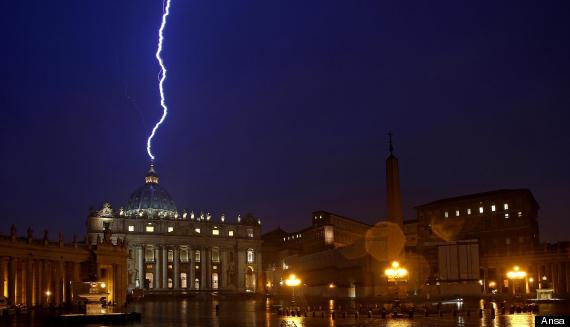
Lightning strikes St Peter's dome at Vatican on day the Pope announced resignation 2013
APOCALYPSE BIBLE
The Lord Jesus will descend from heaven with a cry of command, and the dead will rise first believers. Then the bodies of true Christians, still alive, will be
transformed and brought together believers resurrected in the clouds to
meet the Lord in the air to be with him always.
cf. St. Paul to the Thessalonians, The Epistle 4: 16-17God has foretold that the conditions of humanity worsen to the point that he will speak with terrible judgments described in Revelation.Already today the framework of our society corresponds to the following prophecy of the Apostle Paul: "In the last days perilous times, because men are selfish, lovers of money, boasters, proud, blasphemers, disobedient to parents, ungrateful, unholy, insensitive, unfair, false accusers, incontinent, fierce, despisers of good, traitors, reckless, puffed up, lovers of pleasure rather than God, having a form of godliness but denying its power ", that will carry the name of Christians without being (II Timothy 3: 1-5).Our society is invaded by a wave of dirt and moral degeneration. What is wicked in the sight of God becomes more and more accepted by the world. The religious circles are no different; There are associations of homosexual priests and pastors, and in many environments premarital relations are no longer defined as fornication. Jesus foretold that on his return the situation on the ground would have been like in the days before the flood (Matthew 24:37).It is sad that after so much progress in all fields the man is morally at this level. If you leaf through the pages of history we are horrified to consider the atrocities committed by false ideals.THE RETURN OF JESUS WILL CHANGE THE SITUATION OF HUMANThe physical world will not end so soon as certain false prophets predict, but now, in contrast with the thought of God, will radically cut down. "The Lord Jesus shall be revealed from heaven with his mighty angels, in flaming fire taking vengeance on them that know not God, and that obey not the gospel of our Lord Jesus. They will be punished with everlasting destruction, rejected by the presence of the Lord and from the glory of his power "(II Thess. 1: 7-9; cf.. Rev. 19: 11-15)."When you say, Peace and safety; then sudden destruction cometh upon them, as travail upon a woman with child; and they shall not escape" (I Thess. 5: 3).SIGNS THAT ANNOUNCE THE RETURN OF JESUS CHRISTThe second coming of Jesus will be characterized by various signs all predicted by Himself. Before enumerate want to draw attention to an important fact. No event of great importance, or punishment (the flood, the destruction of Sodom, the fall of Babylon, that of Jerusalem, etc.) Occurred in history without that God had not predicted long before, to give men the time to repent of their ways and thus escape his righteous judgment.Even today, before the manifestation of His wrath, God warns humanity through His Word to repent, and invites you to convert to Jesus and receive Him as Savior and Lord (Acts 17: 30-31).1. FINAL APOSTASYJesus introduced the speech of his return with the warning: "Watch out that no one deceives you. For many will come in my name, claiming, 'I am the Christ." And will deceive many. ... For there shall arise false Christs, and false prophets, and shall shew great signs and wonders; insomuch that, if it were possible, even the elect. Behold, I have told you "(Matthew 24: 4-5, 11, 24-25). According to the prediction of Jesus in the last times there will be movements that in His name shall shew signs and wonders. Many will claim to be able to enter the kingdom of heaven because they will have prophesied, cast out demons and done many miracles in the name of Jesus, but He will declare to them that no one has ever known (Matthew 7:22).The apostle Paul foretold: "That day shall not come, except there come a falling away and not be revealed the man of sin, the son of perdition" (II Thessalonians 2.3). He further wrote that you would give heed to seducing spirits and doctrines of demons (I Timothy 4: 1).We are witnessing a growing emergence of new religions. Doctrines of demons are killing the inhabitants of the earth, sparing the people of God.It teaches:
all religions have arisen by the will of God and lead to God;
but Jesus said: "I am the way, the truth and the life, no one comes to the Father except through me" (John 14: 6);
the man is basically good, just needs to learn to control his mind;
but God declares: "There is no righteous man on earth who does good and never sins" (Ecclesiastes 7:20); "All have sinned and come short of the glory of God" (Romans 3:23); "Your iniquities have separated you from your God; your sins have hidden his face from you, that he will not hear" (Isaiah 59: 2);
there are several mediators between men and God;
but it is written: "There is one God and one mediator between God and men, Christ Jesus" (1 Timothy 2: 5);
you can be saved by religions, devotion to the saints departed, practicing good works;
but the Bible warns: "In no other is there salvation; for there is no other name under heaven that has been given among men, whereby we must be saved" (Acts 4:12); "It is by grace you have been saved through faith; and that not of yourselves: it is the gift of God. It is not by works, so that no one can boast" (Ephesians 2: 8,9);
Christ is a symbol, a cosmic experience or mystical;
but the Bible says: "In the name of Jesus every knee should bow, in heaven and on earth and under the earth, and every tongue confess that Jesus Christ is Lord, to the glory of God the Father" (Philippians 2: 10,11);
there is no life after death, or eternal punishment;
but God has spoken widely in the Holy Scriptures, and Jesus himself spoke several times and very clearly is that the resurrection of hell;
it also teaches that we are God, the divine is everywhere and it can be reached through meditation;
who is sick is inevitably in sin or lack of faith;
consultation of horoscopes and fortune tellers to know the future;
Dowsing, pranotherapy, homeopathy, acupuncture, yoga, etc. to regain health;
the use of the pendulum, talismans, medals, amulets, love potions, crystals, magic "white";
the opportunity to help the dead with prayers addressed to other deaths, good works and placed;
the new revelations, secrets and mystical apparitions "Christian" that would come from God;
and many other similar doctrines.Also attending séances transmitted on TV, watching movies and programs for children, which draw the occult, magic and paganism, prepare the soul of large and small demonic invasion. The uncontrolled proliferation and growing of these teachings is further confirmation of the fact that we are experiencing in recent times, and that therefore Jesus is about to return.2. WARSJesus went on to say: "You will hear of wars and rumors of wars: see that ye be not troubled, it must come to pass, but the end is not yet. For nation will rise against nation, and kingdom against kingdom" (Matthew 24.6-7 ).
From 1945-1978, in 33 years, there were 133 military conflicts.
From 1978-1987, in just nine years, there were about 70 local wars, ie 50% more than the previous period.
In our day, increase exponentially terrorism, wars, and conflicts of all kinds.3. insurrectional movementsUnrest and ethnic wars of peoples are a sign of the times prophesied by the Lord.Jesus told a parable: "Look at the fig tree and all the trees. When they now shoot forth, ye know of your own selves that summer is now near. So you also, when you see these things happening, know that the kingdom of God is near "(Luke 21: 29-31).The fig tree is the symbol of the people of Israel, while other trees are the symbol of the nations (Ezekiel 31). The return of Israel in Palestine after 2,000 years of dispersion and independence of many African and Asian states are already historical facts. From this we know that the Kingdom of God is near.Jesus predicted that "Jerusalem will be trampled on by the nations until the times of the Gentiles be fulfilled" (Luke 21:24). In 1967 Israel recaptured Jerusalem. The time of the nations is going to end.The last war will be particularly disastrous. The third part of men (which would now be about two billion) will be killed in the conflict (Revelation 9:18).4. faminesJesus foretold famine (Matthew 24: 7; see also Revelation 6: 5-6).The world is divided into two parts. While in the West people have plenty to eat, elsewhere there is a chronic misery. Day after day they die of hunger and disease around 140,000 people.This situation will be exacerbated in the near future, given that poor peoples, which already can not feed themselves sufficiently, they multiply faster than rich ones.5. EARTHQUAKESThe increase in earthquakes is impressive. According to the statistics of the Observatory of Strasbourg that
in the seventeenth century were recorded - 378 earthquakes (which does not mean that it occurred others, who have not been registered.
in the eighteenth century - 640 earthquakes
in the nineteenth century (until 1930) - 2119 earthquakes.Today there is more time to count them. Moreover, floods, typhoons, hurricanes sow more and more massacres, ruins and grief."... All these are the beginning of sorrows" (literally: travail - Matthew 24.8). The pains increase in intensity as it approaches the time of childbirth.
cf. St. Paul to the Thessalonians, The Epistle 4: 16-17God has foretold that the conditions of humanity worsen to the point that he will speak with terrible judgments described in Revelation.Already today the framework of our society corresponds to the following prophecy of the Apostle Paul: "In the last days perilous times, because men are selfish, lovers of money, boasters, proud, blasphemers, disobedient to parents, ungrateful, unholy, insensitive, unfair, false accusers, incontinent, fierce, despisers of good, traitors, reckless, puffed up, lovers of pleasure rather than God, having a form of godliness but denying its power ", that will carry the name of Christians without being (II Timothy 3: 1-5).Our society is invaded by a wave of dirt and moral degeneration. What is wicked in the sight of God becomes more and more accepted by the world. The religious circles are no different; There are associations of homosexual priests and pastors, and in many environments premarital relations are no longer defined as fornication. Jesus foretold that on his return the situation on the ground would have been like in the days before the flood (Matthew 24:37).It is sad that after so much progress in all fields the man is morally at this level. If you leaf through the pages of history we are horrified to consider the atrocities committed by false ideals.THE RETURN OF JESUS WILL CHANGE THE SITUATION OF HUMANThe physical world will not end so soon as certain false prophets predict, but now, in contrast with the thought of God, will radically cut down. "The Lord Jesus shall be revealed from heaven with his mighty angels, in flaming fire taking vengeance on them that know not God, and that obey not the gospel of our Lord Jesus. They will be punished with everlasting destruction, rejected by the presence of the Lord and from the glory of his power "(II Thess. 1: 7-9; cf.. Rev. 19: 11-15)."When you say, Peace and safety; then sudden destruction cometh upon them, as travail upon a woman with child; and they shall not escape" (I Thess. 5: 3).SIGNS THAT ANNOUNCE THE RETURN OF JESUS CHRISTThe second coming of Jesus will be characterized by various signs all predicted by Himself. Before enumerate want to draw attention to an important fact. No event of great importance, or punishment (the flood, the destruction of Sodom, the fall of Babylon, that of Jerusalem, etc.) Occurred in history without that God had not predicted long before, to give men the time to repent of their ways and thus escape his righteous judgment.Even today, before the manifestation of His wrath, God warns humanity through His Word to repent, and invites you to convert to Jesus and receive Him as Savior and Lord (Acts 17: 30-31).1. FINAL APOSTASYJesus introduced the speech of his return with the warning: "Watch out that no one deceives you. For many will come in my name, claiming, 'I am the Christ." And will deceive many. ... For there shall arise false Christs, and false prophets, and shall shew great signs and wonders; insomuch that, if it were possible, even the elect. Behold, I have told you "(Matthew 24: 4-5, 11, 24-25). According to the prediction of Jesus in the last times there will be movements that in His name shall shew signs and wonders. Many will claim to be able to enter the kingdom of heaven because they will have prophesied, cast out demons and done many miracles in the name of Jesus, but He will declare to them that no one has ever known (Matthew 7:22).The apostle Paul foretold: "That day shall not come, except there come a falling away and not be revealed the man of sin, the son of perdition" (II Thessalonians 2.3). He further wrote that you would give heed to seducing spirits and doctrines of demons (I Timothy 4: 1).We are witnessing a growing emergence of new religions. Doctrines of demons are killing the inhabitants of the earth, sparing the people of God.It teaches:
all religions have arisen by the will of God and lead to God;
but Jesus said: "I am the way, the truth and the life, no one comes to the Father except through me" (John 14: 6);
the man is basically good, just needs to learn to control his mind;
but God declares: "There is no righteous man on earth who does good and never sins" (Ecclesiastes 7:20); "All have sinned and come short of the glory of God" (Romans 3:23); "Your iniquities have separated you from your God; your sins have hidden his face from you, that he will not hear" (Isaiah 59: 2);
there are several mediators between men and God;
but it is written: "There is one God and one mediator between God and men, Christ Jesus" (1 Timothy 2: 5);
you can be saved by religions, devotion to the saints departed, practicing good works;
but the Bible warns: "In no other is there salvation; for there is no other name under heaven that has been given among men, whereby we must be saved" (Acts 4:12); "It is by grace you have been saved through faith; and that not of yourselves: it is the gift of God. It is not by works, so that no one can boast" (Ephesians 2: 8,9);
Christ is a symbol, a cosmic experience or mystical;
but the Bible says: "In the name of Jesus every knee should bow, in heaven and on earth and under the earth, and every tongue confess that Jesus Christ is Lord, to the glory of God the Father" (Philippians 2: 10,11);
there is no life after death, or eternal punishment;
but God has spoken widely in the Holy Scriptures, and Jesus himself spoke several times and very clearly is that the resurrection of hell;
it also teaches that we are God, the divine is everywhere and it can be reached through meditation;
who is sick is inevitably in sin or lack of faith;
consultation of horoscopes and fortune tellers to know the future;
Dowsing, pranotherapy, homeopathy, acupuncture, yoga, etc. to regain health;
the use of the pendulum, talismans, medals, amulets, love potions, crystals, magic "white";
the opportunity to help the dead with prayers addressed to other deaths, good works and placed;
the new revelations, secrets and mystical apparitions "Christian" that would come from God;
and many other similar doctrines.Also attending séances transmitted on TV, watching movies and programs for children, which draw the occult, magic and paganism, prepare the soul of large and small demonic invasion. The uncontrolled proliferation and growing of these teachings is further confirmation of the fact that we are experiencing in recent times, and that therefore Jesus is about to return.2. WARSJesus went on to say: "You will hear of wars and rumors of wars: see that ye be not troubled, it must come to pass, but the end is not yet. For nation will rise against nation, and kingdom against kingdom" (Matthew 24.6-7 ).
From 1945-1978, in 33 years, there were 133 military conflicts.
From 1978-1987, in just nine years, there were about 70 local wars, ie 50% more than the previous period.
In our day, increase exponentially terrorism, wars, and conflicts of all kinds.3. insurrectional movementsUnrest and ethnic wars of peoples are a sign of the times prophesied by the Lord.Jesus told a parable: "Look at the fig tree and all the trees. When they now shoot forth, ye know of your own selves that summer is now near. So you also, when you see these things happening, know that the kingdom of God is near "(Luke 21: 29-31).The fig tree is the symbol of the people of Israel, while other trees are the symbol of the nations (Ezekiel 31). The return of Israel in Palestine after 2,000 years of dispersion and independence of many African and Asian states are already historical facts. From this we know that the Kingdom of God is near.Jesus predicted that "Jerusalem will be trampled on by the nations until the times of the Gentiles be fulfilled" (Luke 21:24). In 1967 Israel recaptured Jerusalem. The time of the nations is going to end.The last war will be particularly disastrous. The third part of men (which would now be about two billion) will be killed in the conflict (Revelation 9:18).4. faminesJesus foretold famine (Matthew 24: 7; see also Revelation 6: 5-6).The world is divided into two parts. While in the West people have plenty to eat, elsewhere there is a chronic misery. Day after day they die of hunger and disease around 140,000 people.This situation will be exacerbated in the near future, given that poor peoples, which already can not feed themselves sufficiently, they multiply faster than rich ones.5. EARTHQUAKESThe increase in earthquakes is impressive. According to the statistics of the Observatory of Strasbourg that
in the seventeenth century were recorded - 378 earthquakes (which does not mean that it occurred others, who have not been registered.
in the eighteenth century - 640 earthquakes
in the nineteenth century (until 1930) - 2119 earthquakes.Today there is more time to count them. Moreover, floods, typhoons, hurricanes sow more and more massacres, ruins and grief."... All these are the beginning of sorrows" (literally: travail - Matthew 24.8). The pains increase in intensity as it approaches the time of childbirth.
6. THE ANTICHRISTAccording to biblical prophecy will rise the last empire in history, which will bring together European states. Then he will manifest the great dictator of recent times: the Antichrist who will rule for seven years.The world acclaim him as a liberator. He will establish a pact of "peace" with the nations and the people of Israel, deceived by him, him acclaim as the Messiah and as Christ. After three and a half break this covenant and reveal his satanic nature. Then there will be great tribulation, a period of persecution, famine, pestilence and earthquakes. The Antichrist will force everyone to take a mark on their right hand or forehead, without which no one can buy or sell. Those who refuse to take it will be killed. But anyone accept that brand (the name of the Antichrist or his number, which is 666) will be eternally condemned by God (Daniel 9: 24-27; Matthew 24:15, 21-22; Revelation 13: 11-18; 14 : 9-11; II Thessalonians 2: 8).In our day (2000) we are already in the full formation of the United States of Europe as a political unity, economic and military.In this time, the time established by the Lord, you will have to make the wonderful event known as the rapture of the Church, ie the instantaneous disappearance of those who are faithful to Christ and his Word.The signs that characterize the return of the Lord, are being fulfilled before our eyes with increasing pace, so there is no time to lose. As the apostle Peter urge: "Save yourselves from this untoward generation" (Acts 2:40).WHAT TO DO?It should:
Repent of their sins by confessing them to Jesus and Priest ask for forgiveness,
accept the salvation He offers thanks to his sacrifice on the cross,
and make Him the Lord of your life, by following him day by day.With this act of faith in Jesus Christ can receive eternal life and become a child of God (John 1:12; 3:36).May you open your heart to the love of Jesus Christ, who loves you and died to pay with his blood even the debt of your sins!Only by accepting Jesus as Savior and living for Him, you can escape the terrible judgments on the horizon and an eternity even more terrible.If the Holy Spirit has awakened your conscience does not ignore his warning until you've made the salvation in Jesus Christ, the only One who can save you.
POPE LIST BY WIKIPEDIA
| Nome pontificale | Ritratto | Stemma | Inizio pontificato |
Fine pontificato |
Nome secolare | Luogo di nascita | Sepoltura | № |
|---|---|---|---|---|---|---|---|---|
| San Pietro |  |
33 | 29 giugno 67 | Šim’ôn (Simone) | Betsaida, Regno di Giudea | Necropoli vaticana | 1 | |
| San Lino |  |
67 | 23 settembre 76 | Volterra,  Impero romano Impero romano |
Necropoli vaticana | 2 | ||
| Sant'Anacleto |  |
76 | 26 aprile 88 | Atene, Impero romano |
Necropoli vaticana | 3 | ||
| San Clemente I |  |
88 | circa nel 97 | Roma, Impero romano |
Basilica di San Clemente | 4 | ||
| Sant'Evaristo |  |
97 | 27 ottobre 105 | Betlemme, Impero romano |
Necropoli vaticana | 5 | ||
| Nome pontificale | Ritratto | Stemma | Inizio pontificato |
Fine pontificato |
Nome secolare | Luogo di nascita | Sepoltura | № |
II secolo


III secolo


IV secolo


V secolo


VI secolo


VII secolo


VIII secolo


IX secolo


X secolo


II millennio
XI secolo


XII secolo
| Nome pontificale | Ritratto | Stemma | Inizio pontificato |
Fine pontificato |
Nome secolare | Luogo di nascita | Sepoltura | № |
|---|---|---|---|---|---|---|---|---|
| Gelasio II |  |
24 gennaio 1118 | 29 gennaio 1119 | Giovanni dei Caetani | Gaeta,  Ducato di Gaeta Ducato di Gaeta |
Monastero di Cluny | 161 | |
| Callisto II |  |
2 febbraio 1119 | 13 dicembre 1124 | Gui de Bourgogne | Quingey,  Franca Contea di Borgogna (SRI) Franca Contea di Borgogna (SRI) |
Basilica di San Giovanni in Laterano | 162 | |
| Onorio II |  |
15 dicembre 1124 | 13 febbraio 1130 | Lamberto Scannabecchi da Fiagnano | Fiagnano, Romagna (de facto  Sacro Romano Impero) Sacro Romano Impero) |
Basilica di San Giovanni in Laterano | 163 | |
| Innocenzo II |  |
14 febbraio 1130 | 24 settembre 1143 | Gregorio Papareschi | Roma,  Stato Pontificio Stato Pontificio |
Basilica di Santa Maria in Trastevere | 164 |
PROPHECY ALL POPES BY WIKIPEDIA
| Pre-appearance Popes (1143–1590) | |||||
|---|---|---|---|---|---|
| Motto No. | Motto (Translation) | Regnal Name (Reign) | Name | Explanation Provided in Lignum Vitae | Coat of Arms |
| Ex caſtro Tiberis. | Cœleſtinus. ij. | Typhernas. | |||
| 1. | From a castle of the Tiber | Celestine II(1143–1144) | Guido de Castello | An inhabitant of Tifernum. Celestine II was born in Città di Castello (formerly called Tifernum-Tiberinum), on the banks of theTiber.[20] | |
| Inimicus expulſus. | Lucius. ij. | De familia Caccianemica. | |||
| 2. | Enemy expelled | Lucius II(1144–1145) | Gherardo Caccianemici del Orso | Of the Caccianemici family. According to Wion, this motto refers to Lucius II's family name, Caccianemici; in Italian, “Cacciare” means “to drive out” and “nemici” means “enemies”.[21] While he has been traditionally viewed as being part of this family, it is doubtful whether he actually was; moreover, even if he actually belonged to that family, the attribution of the surname Caccianemici is certainly anachronistic.[22] | |
| Ex magnitudine mõtis. | Eugenius. iij. | Patria Ethruſcus oppido Montis magni. | |||
| 3. | From the great mountain | Eugene III(1145–1153) | Bernardo dei Paganelli di Montemagno | Tuscan by nation, from the town of Montemagno. According to Wion, the motto refers to Eugene III’s birthplace, “Montemagno”, a village near Pisa.[23] But according to other sources he was born in Pisa in modest family.[24][25][26] | |
| Abbas Suburranus. | Anaſtaſius. iiij. | De familia Suburra. | |||
| 4. | Abbot from Subbura | Anastasius IV (1153–1154) | Corrado di Suburra | From the Suburra family.[23] He was traditionally referred to as abbot of the canon regulars of St. Ruf in Avignon, but modern scholars have established that he actually belonged to the secular clergy.[27] | |
| De rure albo. | Adrianus. iiij. | Vilis natus in oppido Sancti Albani. | |||
| 5. | From the white countryside | Adrian IV(1154–1159) | Nicholas Breakspear | Humbly born in the town of St. Albans. Most likely a reference to Adrian IV's birthplace near St Albans, Hertfordshire.[28] | |
| Ex tetro carcere. | Victor. iiij. | Fuit Cardinalis S. Nicolai in carcere Tulliano. | |||
| 6. | Out of a loathsome prison. | Victor IV, Antipope (1159–1164) | Ottaviano Monticello | He was a cardinal of St. Nicholas in the Tullian prison. Victor IV may have held the title San Nicola in Carcere.[29] | |
| Via Tranſtiberina. | Calliſtus. iij. [sic] | Guido Cremenſis Cardinalis S. Mariæ Tranſtiberim. | |||
| 7. | Road across the Tiber. | Callixtus III, Antipope (1168–1178) | Giovanni di Strumi | Guido of Crema, Cardinal of St. Mary across the Tiber. Wion reverses the names and order of Antipopes Callixtus III (John of Struma) and Paschal III (Guido of Crema). Paschal, not Callixtus, was born Guido of Crema and held the title of Santa Maria in Trastevere, to which the motto applies.[30] | |
| De Pannonia Thuſciæ. | Paſchalis. iij. [sic] | Antipapa. Hungarus natione, Epiſcopus Card. Tuſculanus. | |||
| 8. | From Tusculan Hungary. | Paschal III, Antipope (1164–1168) | Guido di Crema | Antipope. A Hungarian by birth, Cardinal Bishop of Tusculum. As noted above, this motto applies not to Paschal III, but to Callixtus III, who allegedly was Hungarian.[30]However, Callixtus was Cardinal Bishop of Albano, not of Tusculum.[31] | |
| Ex anſere cuſtode. | Alexander. iij. | De familia Paparona. | |||
| 9. | From the guardian goose | Alexander III (1159–1181) | Rolando (or Orlando) of Siena | Of the Paparoni family. Alexander III may have been from the Bandinella family, which was afterwards known as the Paparona family, which featured a goose on its coat of arms. There is debate whether Alexander III was in fact of that family.[32] | |
| Lux in oſtio. | Lucius. iij. | Lucenſis Card. Oſtienſis. | |||
| 10. | A light in the door | Lucius III(1181–1185) | Ubaldo Allucingoli | A Luccan Cardinal of Ostia.The motto is a wordplay on "Lucius" or "Lucca" and "Ostia".[33] | |
| Sus in cribro. | Vrbanus. iij. | Mediolanenſis, familia cribella, quæ Suem pro armis gerit. | |||
| 11. | Pig in a sieve | Urban III(1185–1187) | Umberto Crivelli | A Milanese, of the Cribella (Crivelli) family, which bears a pig for arms. Urban III's family name Crivelli means "a sieve" in Italian; his arms included a sieve and two pigs.[34] | |
| Enſis Laurentii. | Gregorius. viij. | Card. S. Laurentii in Lucina, cuius inſignia enſes falcati. | |||
| 12. | The sword of Lawrence | Gregory VIII (1187) | Alberto De Morra | Cardinal of St. Lawrence in Lucina, of whom the arms were curved swords. Gregory VIII was Cardinal of St. Lawrence and his arms featured crossed swords.[35] | |
| De Schola exiet.[36] | Clemens. iij. | Romanus, domo Scholari. | |||
| 13. | He will come from school | Clement III(1187–1191) | Paolo Scolari | A Roman, of the house of Scolari. The motto is a play on words on Clement III's surname.[37] | |
| De rure bouenſi. | Cœleſtinus. iij. | Familia Bouenſi. | |||
| 14. | From cattle country | Celestine III (1191–1198) | Giacinto Bobone | Bovensis family. The reference to cattle is a wordplay on Celestine III's surname, Bobone.[38] | |
| Comes Signatus. | Innocentius. iij. | Familia Comitum Signiæ. | |||
| 15. | Designated count | Innocent III(1198–1216) | Lotario dei Conti di Segni | Family of the Counts of Signia (Segni) The motto is a direct reference to Innocent III's family name.[39] |  |
| Canonicus de latere. | Honorius. iij. | Familia Sabella, Canonicus S. Ioannis Lateranensis. | |||
| 16. | Canon from the side | Honorius III (1216–1227) | Cencio Savelli | Savelli family, canon of St. John Lateran The claim in Wion that Honorius III was a canon of St. John Lateran is contested by some historians.[37] |  |
| Auis Oſtienſis. | Gregorius. ix. | Familia Comitum Signiæ Epiſcopus Card. Oſtienſis. | |||
| 17. | Bird of Ostia | Gregory IX(1227–1241) | Ugolino dei Conti di Segni | Family of the Counts of Segni, Cardinal Bishop of Ostia. Before his election to the papacy, Ugolino dei Conti was the Cardinal Bishop of Ostia, and his coat of arms depict an eagle.[40] | |
| Leo Sabinus. | Cœleſtinus iiij. | Mediolanenſis, cuius inſignia Leo, Epiſcopus Card. Sabinus. | |||
| 18. | Sabine Lion | Celestine IV (1241) | Goffredo Castiglioni | A Milanese, whose arms were a lion, Cardinal Bishop of Sabina. Celestine IV was Cardinal Bishop of Sabina and his armorial bearing had a lion in it.[41] |  |
| Comes Laurentius. | Innocentius iiij. | domo flisca, Comes Lauaniæ, Cardinalis S. Laurentii in Lucina. | |||
| 19. | Count Lawrence | Innocent IV(1243–1254) | Sinibaldo Fieschi | Of the house of Flisca (Fieschi), Count of Lavagna, Cardinal of St. Lawrence in Lucina. The motto, as explained in Wion, is a reference to Innocent IV's father, the Count of Lavagna, and his title Cardinal of St. Lawrence in Lucina.[41] |  |
| Signum Oſtienſe. | Alexander iiij. | De comitibus Signiæ, Epiſcopus Card. Oſtienſis. | |||
| 20. | Sign of Ostia | Alexander IV (1254–1261) | Renaldo dei Signori di Ienne | Of the counts of Segni, Cardinal Bishop of Ostia. The motto refers to Alexander IV's being Cardinal Bishop of Ostia and member of the Conti-Segni family.[41] | |
| Hieruſalem Campanię. | Vrbanus iiii. | Gallus, Trecenſis in Campania, Patriarcha Hieruſalem. | |||
| 21. | Jerusalem of Champagne | Urban IV(1261–1264) | Jacques Pantaleon | A Frenchman, of Trecae (Troyes) in Champagne, Patriarch of Jerusalem. The motto refers to Urban IV's birthplace of Troyes, Champagne, and title Patriarch of Jerusalem.[42] |  |
| Draco depreſſus. | Clemens iiii. | cuius inſignia Aquila vnguibus Draconem tenens. | |||
| 22. | Dragon pressed down | Clement IV(1265–1268) | Guido Fulcodi | Whose badge is an eagle holding a dragon in his talons. According some sources, Clement IV's coat of arms depicted an eagle clawing a dragon. Other sources indicate that it was instead six fleurs-de-lis.[43] |  |
| Anguinus uir. | Gregorius. x. | Mediolanenſis, Familia vicecomitum, quæ anguẽ pro inſigni gerit. | |||
| 23. | Snaky man | Gregory X(1271–1276) | Teobaldo Visconti | A Milanese, of the family of Viscounts (Visconti), which bears a snake for arms. The Visconti coat of arms had a large serpent devouring a male child feet first; sources conflict as to whether Gregory X used this for his papal arms.[44] |  |
| Concionator Gallus. | Innocentius. v. | Gallus, ordinis Prædicatorum. | |||
| 24. | French Preacher | Innocent V(1276) | Pierre de Tarentaise | A Frenchman, of the Order of Preachers. Innocent V was born in what is now south-eastern France and was a member of the order of Preachers.[45] |  |
| Bonus Comes. | Adrianus. v. | Ottobonus familia Fliſca ex comitibus Lauaniæ. | |||
| 25. | Good Count | Adrian V(1276) | Ottobono Fieschi | Ottobono, of the Fieschi family, from the counts of Lavagna. The Fieschi family were counts of Lavagna and a wordplay on "good" can be made with Adrian V's first name, Ottobono.[46] | |
| Piſcator Thuſcus. | Ioannes. xxi. | antea Ioannes Petrus Epiſcopus Card. Tuſculanus. | |||
| 26. | Tuscan Fisherman | John XXI(1276–1277) | Pedro Julião | Formerly John Peter, Cardinal Bishop of Tusculum. John XXI had been the Cardinal Bishop of Tusculum, and shared his first name with Saint Peter, a fisherman.[47] |  |
| Roſa compoſita. | Nicolaus. iii. | Familia Vrſina, quæ roſam in inſigni gerit, dictus compoſitus. | |||
| 27. | Composite Rose | Nicholas III(1277–1280) | Giovanni Gaetano Orsini | Of the Ursina (Orsini) family, which bears a rose on its arms, called 'composite'. Nicholas III bore a rose in his coat of arms.[47] |  |
| Ex teloneo liliacei Martini. | Martinus. iiii. | cuius inſignia lilia, canonicus, & theſaurarius S. Martini Turonen[sis]. | |||
| 28. | From the tollhouse of Martin of the lilies | Martin IV(1281–1285) | Simone de Brion | Whose arms were lilies, canon and treasurer of St. Martin of Tours. Martin IV was Canon and Treasurer at the Church of St. Martin in Tours, France.[48] Wion's assertion that his arms featured lilies is incorrect.[49] |  |
| Ex roſa leonina. | Honorius. iiii. | Familia Sabella inſignia roſa à leonibus geſtata. | |||
| 29. | Out of the leonine rose | Honorius IV (1285–1287) | Giacomo Savelli | Of the Sabella (Savelli) family, arms were a rose carried by lions. Honorius IV's coat of arms was emblazoned with two lions supporting a rose.[50] | |
| Picus inter eſcas. | Nicolaus. iiii. | Picenus patria Eſculanus.[51] | |||
| 30. | Woodpecker between food | Nicholas IV(1288–1292) | Girolamo Masci | A Picene by nation, of Asculum (Ascoli). The motto is likely an obscure wordplay on Nicholas IV's birthplace in Ascoli, in Picenum.[50] |  |
| Ex eremo celſus. | Cœleſtinus. v. | Vocatus Petrus de morrone Eremita. | |||
| 31. | Raised out of the desert | Celestine V(1294) | Pietro Di Murrone | Called Peter de Morrone, a hermit. Prior to his election, Celestine V was a hermit (eremita, literally a dweller in the eremus, or desert).[52] |  |
| Ex undarũ bn̑dictione. | Bonifacius. viii. | Vocatus prius Benedictus, Caetanus, cuius inſignia undæ. | |||
| 32. | From the blessing of the waves | Boniface VIII (1294–1303) | Benedetto Caetani | Previously called Benedict, of Gaeta, whose arms were waves. Boniface VIII's coat of arms had a wave through it. Also a play on words, referring to the pope's Christian name, "Benedetto."[53] |  |
| Concionator patereus. [sic] | Benedictus. xi. | qui uocabatur Frater Nicolaus, ordinis Prædicatorum. | |||
| 33. | Preacher From Patara | Benedict XI(1303–1304) | Nicholas Boccasini | Who was called Brother Nicholas, of the order of Preachers. Benedict XI belonged to the Order of Preachers, and his namesake Saint Nicholas was from Patara. O'Brien notes, "Everything leads us to suspect that the author and interpreter of the prophecy is one and the same person. The pretended interpreter who knew that Patare was the birthplace of St. Nicholas forgot that others may not be aware of the fact, and that therefore the explanation would be thrown away on them."[19] |  |
| De feſſis aquitanicis. | Clemens V. | natione aquitanus, cuius inſignia feſſæ erant. | |||
| 34. | From the fesses of Aquitaine | Clement V(1305–1314) | Bertrand de Got | An Aquitanian by birth, whose arms were fesses. Clement V was Bishop of St-Bertrand-de-Comminges in Aquitaine, and eventually became Archbishop of Bordeaux, also in Aquitaine. His coat of arms displays three horizontal bars, known in heraldry asfesses.[54] |  |
| De ſutore oſſeo. | Ioannes XXII. | Gallus, familia Oſſa, Sutoris filius. | |||
| 35. | From a bony cobbler | John XXII(1316–1334) | Jacques Duese | A Frenchman, of the Ossa family, son of a cobbler. John XXII's family name was Duèze or D'Euse, the last of which might be back-translated into Latin as Ossa ("bones"), the name Wion gives. The popular legend that his father was a cobbler is dubious.[55] |  |
| Coruus ſchiſmaticus. | Nicolaus V. | qui uocabatur F. Petrus de corbario, contra Ioannem XXII. Antipapa Minorita. | |||
| 36. | Schismatic crow | Nicholas V, Antipope (1328–1330) | Pietro Rainalducci di Corvaro | Who was called Brother Peter of Corbarium (Corvaro), the Minorite antipope opposing John XXII. The motto is a play on words, referring to Pietro di Corvaro's last name.[56] | |
| Frigidus Abbas. | Benedictus XII. | Abbas Monaſterii fontis frigidi. | |||
| 37. | Cold abbot | Benedict XII (1334–1342) | Jacques Fournier | Abbot of the monastery of the cold spring. Benedict XII was an abbot in the monastery of Fontfroide ("cold spring").[57] |  |
| De roſa Attrebatenſi. | Clemens VI. | Epiſcopus Attrebatenſis, cuius inſignia Roſæ. | |||
| 38. | From the rose of Arras | Clement VI(1342–1352) | Pierre Roger | Bishop of Arras, whose arms were roses. Clement VI was Bishop of Arras (in Latin, Episcopus Attrebatensis) and his armorial bearings were emblazoned with six roses.[58] |  |
| De mõtibus Pãmachii. | Innocentius VI. | Cardinalis SS. Ioannis & Pauli. T. Panmachii, cuius inſignia ſex montes erant. | |||
| 39. | From the mountains of Pammachius | Innocent VI(1352–1362) | Etienne Aubert | Cardinal of Saints John and Paul, Titulus of Pammachius, whose arms were six mountains. Innocent VI was Cardinal Priest of Pammachius. Wion and Panvinio describe his arms as depicting six mountains, though other sources do not.[59] |  |
| Gallus Vicecomes. | Vrbanus V. | nuncius Apoſtolicus ad Vicecomites Mediolanenſes. | |||
| 40. | French viscount | Urban V(1362–1370) | Guglielmo De Grimoard | Apostolic nuncio to the Viscounts of Milan. Urban V was French.[60] Wion indicates he was Apostolic Nuncio to the Viscounts of Milan.[61] |  |
| Nouus de uirgine forti. | Gregorius XI. | qui uocabatur Petrus Belfortis, Cardinalis S. Mariæ nouæ. | |||
| 41. | New man from the strong virgin | Gregory XI(1370–1378) | Pierre Roger de Beaufort | Who was called Peter Belfortis (Beaufort), Cardinal of New St. Mary's. The motto refers to Gregory XI's surname and his title Cardinal of Santa Maria Nuova.[62] | |
| Decruce Apoſtolica. [sic] | Clemens VII. | qui fuit Preſbyter Cardinalis SS. XII. Apoſtolorũ cuius inſignia Crux. | |||
| 42. | From the apostolic cross | Clement VII, Antipope (1378–1394) | Robert, Count of Geneva | Who was Cardinal Priest of the Twelve Holy Apostles, whose arms were a cross. Clement VII's coat of arms showed a cross and he held the title Cardinal Priest of the Twelve Holy Apostles.[63] | .svg) |
| Luna Coſmedina. | Benedictus XIII. | antea Petrus de Luna, Diaconus Cardinalis S. Mariæ in Coſmedin. | |||
| 43. | Cosmedine moon. | Benedict XIII, Antipope (1394–1423) | Peter de Luna | Formerly Peter de Luna, Cardinal Deacon of St. Mary in Cosmedin. The motto refers to Benedict XIII's surname and title.[64] | .svg) |
| Schiſma Barchinoniũ. | Clemens VIII. | Antipapa, qui fuit Canonicus Barchinonenſis. | |||
| 44. | Schism of the Barcelonas | Clement VIII, Antipope (1423–1429) | Gil Sanchez Muñoz | Antipope, who was a canon of Barcelona.[64] | |
| De inferno prægnãti. | Vrbanus VI. | Neapolitanus Pregnanus, natus in loco quæ dicitur Infernus. | |||
| 45. | From a pregnant hell. | Urban VI(1378–1389) | Bartolomeo Prignano | The Neapolitan Prignano, born in a place which is called Inferno. Urban VI's family name was Prignano or Prignani, and he was native to a place called Inferno near Naples.[65] |  |
| Cubus de mixtione. | Bonifacius. IX. | familia tomacella à Genua Liguriæ orta, cuius inſignia Cubi. | |||
| 46. | Square of mixture | Boniface IX(1389–1404) | Pietro Tomacelli | Of the Tomacelli family, born in Genoa in Liguria, whose arms were cubes. Boniface IX's coat of arms includes a bend checky — a wide stripe with a checkerboard pattern.[66] |  |
| De meliore ſydere. | Innocentius. VII. | uocatus Coſmatus de melioratis Sulmonenſis, cuius inſignia ſydus. | |||
| 47. | From a better star | Innocent VII (1404–1406) | Cosmo Migliorati | Called Cosmato dei Migliorati of Sulmo, whose arms were a star. The motto is a play on words, "better" (melior) referring to Innocent VII's last name, Migliorati (Meliorati). There is a shooting star on his coat of arms.[66] |  |
| Nauta de Ponte nigro. | Gregorius XII. | Venetus, commendatarius eccleſiæ Nigropontis. | |||
| 48. | Sailor from a black bridge | Gregory XII(1406–1415) | Angelo Correr | A Venetian, commendatary of the church of Negroponte. Gregory XII was born in Venice (hence mariner) and was commendatary of Chalkis, then called Negropont.[67] |  |
| Flagellum ſolis. | Alexander. V. | Græcus Archiepiſcopus Mediolanenſis, inſignia Sol. | |||
| 49. | Whip of the sun | Alexander V, Antipope (1409–1410) | Petros Philarges | A Greek, Archbishop of Milan, whose arms were a sun. Alexander V's coat of arms featured a sun, the wavy rays may explain the reference to a whip.[68] | .svg) |
| Ceruus Sirenæ. | Ioannes XXIII. | Diaconus Cardinalis S. Euſtachii, qui cum ceruo depingitur, Bononiæ legatus, Neapolitanus. | |||
| 50. | Stag of the siren | John XXIII, Antipope (1410–1415) | Baldassarre Cossa | Cardinal Deacon of St. Eustace, who is depicted with a stag; legate of Bologna, a Neapolitan. John XXIII was a cardinal with the title of St. Eustachius, whose emblem is a stag, and was originally from Naples, which has the emblem of the siren.[68] | |
| Corona ueli aurei. | Martinus V. | familia colonna, Diaconus Cardinalis S. Georgii ad uelum aureum. | |||
| 51. | Crown of the golden curtain | Martin V(1417–1431) | Oddone Colonna | Of the Colonna family, Cardinal Deacon of St. George at the golden curtain. The motto is a reference to Martin V's family name and cardinal title of San Giorgio in Velabro.[69] |  |
| Lupa Cœleſtina, | Eugenius. IIII. | Venetus, canonicus antea regularis Cœleſtinus, & Epiſcopus Senẽſis. | |||
| 52. | Heavenly she-wolf | Eugene IV(1431–1447) | Gabriele Condulmaro | A Venetian, formerly a regular Celestine canon, and Bishop of Siena. Eugene IV belonged to the order of the Celestines and was the Bishop of Siena which bears a she-wolf on its arms.[70] |  |
| Amator Crucis. | Felix. V. | qui uocabatur Amadæus Dux Sabaudiæ, inſignia Crux. | |||
| 53. | Lover of the cross | Felix V, Antipope (1439–1449) | Amadeus, Duke of Savoy | Who was called Amadeus, Duke of Savoy, arms were a cross. The motto is a reference to Felix V's given name, Amadeus, and arms, which featured the cross of Savoy.[70] | .svg) |
| De modicitate Lunæ. | Nicolaus V. | Lunenſis de Sarzana, humilibus parentibus natus. | |||
| 54. | From the meanness of Luna | Nicholas V(1447–1455) | Tommaso Parentucelli | A Lunese of Sarzana, born to humble parents. Nicholas V was born in the diocese of Luni, the ancient name of which was Luna.[71] |  |
| Bos paſcens. | Calliſtus. III. | Hiſpanus, cuius inſignia Bos paſcens. | |||
| 55. | Pasturing ox | Callixtus III(1455–1458) | Alfonso Borja | A Spaniard, whose arms were a pasturing ox. Callixtus III's coat of arms featured an ox.[71] |  |
| De Capra & Albergo. | Pius. II. | Senenſis, qui fuit à Secretis Cardinalibus Capranico & Albergato. | |||
| 56. | From a nanny-goat and an inn | Pius II(1458–1464) | Enea Silvio de Piccolomini | A Sienese, who was secretary to Cardinals Capranicus and Albergatus. Pius II was secretary to Cardinal Domenico Capranica and Cardinal Albergatti before he was elected Pope.[72] |  |
| De Ceruo & Leone. | Paulus. II. | Venetus, qui fuit Commendatarius eccleſiæ Ceruienſis, & Cardinalis tituli S. Marci. | |||
| 57. | From a stag and lion | Paul II(1464–1471) | Pietro Barbo | A Venetian, who was commendatary of the church of Cervia, and Cardinal of the title of St. Mark. The motto refers to his Bishopric of Cervia (punning on cervus, "a stag") and his Cardinal title of St. Mark (symbolized by a winged lion).[72] |  |
| Piſcator minorita. | Sixtus. IIII. | Piſcatoris filius, Franciſcanus. | |||
| 58. | Minorite fisherman | Sixtus IV(1471–1484) | Francesco Della Rovere | Son of a fisherman, Franciscan. Sixtus IV was born the son of a fisherman and a member of the Franciscans, also known as "Minorites" (which was founded in 1209, after Malachy's death.)[73] |  |
| Præcurſor Siciliæ. | Innocentius VIII. | qui uocabatur Ioãnes Baptiſta, & uixit in curia Alfonſi regis Siciliæ. | |||
| 59. | Precursor of Sicily | Innocent VIII (1484–1492) | Giovanni Battista Cibò | Who was called John Baptist, and lived in the court of Alfonso, king of Sicily. Innocent VIII was from Sicily. "Precursor" may be explained as an allusion to his birth name, after John the Baptist, the precursor of Christ.[74] |  |
| Bos Albanus in portu. | Alexander VI. | Epiſcopus Cardinalis Albanus & Portuenſis, cuius inſignia Bos. | |||
| 60. | Bull of Alba in the harbor | Alexander VI (1492–1503) | Rodrigo de Borgia | Cardinal Bishop of Albano and Porto, whose arms were a bull. In 1456, he was made a Cardinal and he held the titles of Cardinal Bishop of Albano and Porto, and his arms featured an ox.[74] |  |
| De paruo homine. | Pius. III. | Senenſis, familia piccolominea. | |||
| 61. | From a small man | Pius III(1503) | Francesco Todeschini Piccolomini | A Sienese, of the Piccolomini family. Pius III's family name was Piccolomini, from piccolo "small" and uomo "man".[75] | |
| Fructus Iouis iuuabit. | Iulius. II. | Ligur, eius inſignia Quercus, Iouis arbor. | |||
| 62. | The fruit of Jupiter will help | Julius II(1503–1513) | Giuliano Della Rovere | A Genoese, his arms were an oak, Jupiter's tree. On Julius II's arms was an oak tree, which was sacred to Jupiter.[75] | |
| De craticula Politiana. | Leo. X. | filius Laurentii medicei, & ſcholaris Angeli Politiani. | |||
| 63. | From a Politian gridiron | Leo X(1513–1521) | Giovanni de Medici | Son of Lorenzo de' Medici, and student of Angelo Poliziano. Leo X's educator and mentor was Angelo Poliziano. The “Gridiron” in the motto evidently refers to St. Lawrence, who was martyred on a gridiron. This is a rather elliptical allusion to Lorenzo the Magnificent, who was Giovanni’s father.[76] |  |
| Leo Florentius. | Adrian. VI. | Florẽtii filius, eius inſignia Leo. | |||
| 64. | Florentian lion | Adrian VI(1522–1523) | Adriaen Florenszoon Boeyens | Son of Florentius, his arms were a lion. Adrian VI's coat of arms had two lions on it, and his name is sometimes given as Adrian Florens, or other variants, from his father's first name Florens (Florentius).[77] |  |
| Flos pilei ægri. | Clemens. VII. | Florentinus de domo medicea, eius inſignia pila, & lilia. | |||
| 65. | Flower of the sick man's pill[78] | Clement VII(1523–1534) | Giulio de Medici | A Florentine of the Medicean house, his arms were pill-balls and lilies. The Medici coat of arms was emblazoned with six medical balls. One of these balls, the largest of the six, was emblazoned with the Florentine lily.[79] | |
| Hiacinthus medicorũ. | Paulus. III. | Farneſius, qui lilia pro inſignibus geſtat, & Card. fuit SS. Coſme, & Damiani. | |||
| 66. | Hyacinth of the physicians | Paul III(1534–1549) | Alessandro Farnese | Farnese, who bore lilies for arms, and was Cardinal of Saints Cosmas and Damian. According to some sources, Paul III's coat of arms were charged with hyacinths, and he was cardinal of Saints Cosmas and Damian, both doctors.[80] |  |
| De corona montana. | Iulius. III. | antea uocatus Ioannes Maria de monte. | |||
| 67. | From the mountainous crown | Julius III(1550–1555) | Giovanni Maria Ciocchi del Monte | Formerly called Giovanni Maria of the Mountain (de Monte) His coat of arms showed mountains and laurel crowns (chaplets).[81] |  |
| Frumentum flocidum. [sic] | Marcellus. II. | cuius inſignia ceruus & frumẽtum, ideo floccidum, quod pauco tempore uixit in papatu. | |||
| 68. | Trifling grain | Marcellus II(1555) | Marcello Cervini | Whose arms were a stag and grain; 'trifling', because he lived only a short time as pope. His coat of arms showed a stag and ears of wheat.[81] |  |
| De fide Petri. | Paulus. IIII. | antea uocatus Ioannes Petrus Caraffa. | |||
| 69. | From Peter's faith | Paul IV(1555–1559) | Giovanni Pietro Caraffa | Formerly called John Peter Caraffa. Paul IV is said to have used his second Christian name Pietro.[82] |  |
| Eſculapii pharmacum. | Pius. IIII. | antea dictus Io. Angelus Medices. | |||
| 70. | Aesculapius' medicine | Pius IV(1559–1565) | Giovanni Angelo de Medici | Formerly called Giovanni Angelo Medici. The motto is likely a simple allusion to Pius IV's family name.[83] | |
| Angelus nemoroſus. | Pius. V. | Michael uocatus, natus in oppido Boſchi. | |||
| 71. | Angel of the grove | Pius V(1566–1572) | Antonio Michele Ghisleri | Called Michael, born in the town of Bosco. Pius V was born in Bosco, Lombardy; the placename means grove. His name was 'Antonio Michele Ghisleri', and Michele relates to the archangel.[84] O'Brien notes here that many of the prophecies contain plays on Italian words, which are not made explicit in the explanations provided in the Lignum Vitae.[84] |  |
| Medium corpus pilarũ. | Gregorius. XIII. | cuius inſignia medius Draco, Cardinalis creatus à Pio. IIII. qui pila in armis geſtabat. | |||
| 72. | Half body of the balls | Gregory XIII (1572–1585) | Ugo Boncompagni | Whose arms were a half-dragon; a Cardinal created by Pius IV who bore balls in his arms. The "balls" in the motto refer to Pope Pius IV, who had made Gregory a cardinal. Pope Gregory had a dragon on his coat of arms with half a body.[85] |  |
| Axis in medietate ſigni. | Sixtus. V. | qui axem in medio Leonis in armis geſtat. | |||
| 73. | Axle in the midst of a sign. | Sixtus V(1585–1590) | Felice Peretti | Who bears in his arms an axle in the middle of a lion. This is a rather straightforward description of the Sixtus V's coat of arms.[86] |  |
| De rore cœli. | Vrbanus. VII. | qui fuit Archiepiſcopus Roſſanenſis in Calabria, ubi mãna colligitur. | |||
| 74. | From the dew of the sky | Urban VII(1590) | Giovanni Battista Castagna | Who was Archbishop of Rossano in Calabria, where manna is collected. He had been Archbishop of Rossano in Calabria where sap called "the dew of heaven" is gathered from trees.[87] |  |
Popes 1590 to present (post-publication)[edit]
For this group of popes, the published text only provides names for the first three (i.e., those who were popes between the appearance of the text c. 1590, and its publication in 1595) and provides no explanations.
| Post-appearance Popes (1590–present) | |||||
|---|---|---|---|---|---|
| Motto No. | Motto (Translation) | Regnal Name (Reign) | Name | Interpretations and Criticisms | Coat of Arms |
| Ex antiquitate Vrbis. | Gregorius. XIIII. | ||||
| 75. | Of the antiquity of the city / From the old city | Gregory XIV(1590–1591) | Niccolò Sfondrati | This may have been intended by the author of the prophecies to suggest that Cardinal Girolamo Simoncelli was destined to succeed Urban VII. Simoncelli was from Orvieto, which in Latin is Urbs vetus, old city. Simoncelli was not elected pope, however, Niccolò Sfondrati was, who took the name Gregory XIV. Proponents of the prophecies have attempted to explain it by noting that Gregory XIV's father was a senator of the ancient city of Milan, and the word "senator" is derived from the Latinsenex, meaning old man, or that Milan is the "old city" in question, having been founded c. 400 BCE.[88] |  |
| Pia ciuitas in bello. | Innocentius. IX. | ||||
| 76. | Pious citizens in war | Innocent IX (1591) | Giovanni Antonio Facchinetti | Proponents of the prophecies have suggested different interpretations to relate this motto to Innocent IX, including references to his birthplace of Bologna or title ofPatriarch of Jerusalem.[89] |  |
| Crux Romulea. | Clemens. VIII. | ||||
| 77. | Cross of Romulus | Clement VIII (1592–1605) | Ippolito Aldobrandini | Proponents of the prophecies have suggested different interpretations to relate this motto to Clement VIII, including linking it to the embattled bend on his arms or thewar between Catholic Ireland and Protestant England during his papacy.[90] |  |
| Vndoſus uir. | |||||
| 78. | Wavy man | Leo XI(1605) | Alessandro Ottaviano De Medici | This may have been intended by the author of the prophecies to suggest to his audience a possible heraldic design, but it does not correspond to Leo XI's Medici arms. Proponents of the prophecies have suggested different interpretations to relate this motto to this pope, including relating it to his short reign "passing like a wave."[91] | |
| Gens peruerſa. | |||||
| 79. | Wicked race | Paul V(1605–1621) | Camillo Borghese | Proponents of the prophecies have suggested it is a reference to the dragon and the eagle on Paul V's arms.[92] |  |
| In tribulatione pacis. | |||||
| 80. | In the trouble of peace | Gregory XV (1621–1623) | Alessandro Ludovisi | The lack of plausible explanations for this motto leads O'Brien to comment, "The prophet, up to 1590, did not deal in generalities."[93] |  |
| Lilium et roſa. | |||||
| 81. | Lily and rose | Urban VIII(1623–1644) | Maffeo Barberini | This motto again may have been intended to suggest a heraldic device, but not one that matches Urban VIII's arms. Proponents of the prophecies have alternatively suggested that it is a reference to the bees that do occur on his arms, to the fleur-de-lis of his native Florence, or to his dealings in France (the lily) and England (the rose).[94] |  |
| Iucunditas crucis. | |||||
| 82. | Delight of the cross | Innocent X (1644–1655) | Giovanni Battista Pamphili | Proponents of the prophecies have attempted to link this motto to Innocent X by noting that he was raised to the pontificate around the time of the Feast of the Exaltation of the Cross.[95] |  |
| Montium cuſtos. | |||||
| 83. | Guard of the mountains | Alexander VII (1655–1667) | Fabio Chigi | Proponents of the prophecies have attempted to link this motto to Alexander VII by noting that his papal arms include six hills, though this was not an uncommon device, and this explanation would not account for the "guard" portion of the motto.[96] |  |
| Sydus olorum. | |||||
| 84. | Star of the swans | Clement IX (1667–1669) | Giulio Rospigliosi | This again may have been intended to be taken as an allusion to heraldry; O'Brien notes that there is an Italian family with arms featuring a swan with stars, but it had no relation to Clement IX. Proponents of the prophecies have claimed he had a room called the "chamber of swans" during the conclave.[97] |  |
| De flumine magno. | |||||
| 85. | From a great river | Clement X(1670–1676) | Emilio Altieri | Proponents of the prophecies have attempted to link this motto to Clement X by claiming that the Tiber overflowed its banks at his birth, or as an obscure reference to his family name.[98] |  |
| Bellua inſatiabilis. | |||||
| 86. | Insatiable beast | Innocent XI (1676–1689) | Benedetto Odescalchi | Proponents of the prophecies have attempted to link this motto to the lion on Innocent XI's arms.[99] |  |
| Pœnitentia glorioſa. | |||||
| 87. | Glorious penitence | Alexander VIII (1689–1691) | Pietro Ottoboni | Proponents of the prophecies have attempted to link this motto to Alexander VIII by interpreting as a reference to the submission of the Gallican bishops.[100] O'Brien notes, "There are glorious repentances during every pontificate."[101] |  |
| Raſtrum in porta. | |||||
| 88. | Rake in the door[102] | Innocent XII (1691–1700) | Antonio Pignatelli | Some sources discussing the prophecy give Innocent XII's family name as "Pignatelli del Rastello," which would provide a clear way for proponents to connect this motto to this pope (rastello or rastrello is Italian for rake).[103] Others, however, give the pope's family name as simply "Pignatelli", and indicate that it is difficult to find a satisfactory explanation to associate the pope with the motto.[104] |  |
| Flores circundati. | |||||
| 89. | Surrounded flowers | Clement XI (1700–1721) | Giovanni Francesco Albani | A medal of Clement XI was created with the motto, "Flores circumdati", drawn from his description in the prophecies, which were widely circulated at that time.[105] |  |
| De bona religione. | |||||
| 90. | From good religion | Innocent XIII (1721–1724) | Michelangelo dei Conti | Proponents of the prophecies have attempted to link this motto to Innocent XIII by interpreting it as a reference to the fact several popes had come from his family.[106] |  |
| Miles in bello. | |||||
| 91. | Soldier in War | Benedict XIII (1724–1730) | Pietro Francesco Orsini | Proponents of the prophecies have attempted to link this motto to particular wars that occurred during Benedict XIII's pontificate, or a figurative war against decadence in favour of austerity.[107] |  |
| Columna excelſa. | |||||
| 92. | Lofty column | Clement XII (1730–1740) | Lorenzo Corsini | This may have been intended by the author of the prophecies as a reference to a pope of the Colonna family; a similar motto was used to describe to Martin V, who was pope before the publication of the prophecies. Proponents of the prophecies have attempted to link this motto to Clement XII as an allusion to a statue erected in his memory or the use of two columns from the Pantheon of Agrippa in a chapel he built.[108] |  |
| Animal rurale. | |||||
| 93. | Country animal | Benedict XIV(1740–1758) | Marcello Lambertini | This may have been intended as a reference to armorial bearings, but it does not match Benedict XIV's arms. Proponents of the prophecies have attempted to link this motto to this pope as a description of his "plodding ox" diligence.[109] |  |
| Roſa Vmbriæ. | |||||
| 94. | Rose of Umbria | Clement XIII (1758–1769) | Carlo Rezzonico | Proponents of the prophecies have attempted to link this motto to Clement XIII as a reference to his elevation to sainthood of several Franciscans, to which order the motto can refer.[110] |  |
| Vrſus uelox. | |||||
| 95. | Swift bear (later misprinted as Cursus velox Swift Course or Visus velox Swift Glance) | Clement XIV(1769–1774) | Lorenzo Giovanni Vincenzo Antonio Ganganelli | Proponents of the prophecies have struggled to provide a satisfactory explanation of this motto; some authors claim without evidence that the Ganganelli arms featured a running bear, but this is dubious.[111] |  |
| Peregrin9 apoſtolic9.[112] | |||||
| 96. | Apostolic pilgrim | Pius VI(1775–1799) | Giovanni Angelico Braschi | Proponents of the prophecies have attempted to link this motto to Pius VI by suggesting it is a reference to his long reign.[113] |  |
| Aquila rapax. | |||||
| 97. | Rapacious eagle | Pius VII(1800–1823) | Barnaba Chiaramonti | Proponents of the prophecies have attempted to link this motto to Pius VII by suggesting it is a reference to the eagle on the arms of Napoleon, whose reign asEmperor of the French took place during Pius' pontificate.[113] |  |
| Canis & coluber. | |||||
| 98. | Dog and adder | Leo XII(1823–1829) | Annibale Sermattei della Genga | Proponents of the prophecies have attempted to link this motto to Leo XII by suggesting the dog and snake are allusions to his qualities of vigilance and prudence, respectively.[114] |  |
| Vir religioſus. | |||||
| 99. | Religious man | Pius VIII(1829–1830) | Francesco Saverio Castiglioni | Proponents of the prophecies have attempted to link this motto to Pius VIII by suggesting it is a reference to his papal name, or the fact that he was not the first pope from his family.[115] |  |
| De balneis Ethruriæ. | |||||
| 100. | From the baths of Tuscany | Gregory XVI(1831–1846) | Mauro, or Bartolomeo Alberto Cappellari | Proponents of the prophecies have attempted to link this motto to Gregory XVI by suggesting it is a reference to his membership in the Camaldolese Order, founded in the thirteenth century in Fonte Buono, called Balneum in Latin, in Etruria.[116] |  |
| Crux de cruce. | |||||
| 101. | Cross from cross | Pius IX(1846–1878) | Giovanni Maria Mastai Ferretti | Proponents of the prophecies have attempted to link this motto to Pius IX by interpreting it as a reference to his difficulties ("crosses") with the House of Savoy, whose emblem is a cross. O'Brien notes, "A forger would be very disposed to chance some reference to a cross on account of its necessary connexion with all popes as well as the probability of its figuring, in some form or other, on the pope's arms."[117] |  |
| Lumen in cœlo. | |||||
| 102. | Light in the sky | Leo XIII(1878–1903) | Gioacchino Pecci | Proponents of the prophecies have attempted to link this motto to Leo XIII by interpreting it as a reference to the star on his arms. O'Brien notes this coincidence would be much more remarkable had the prophecies referred to sydus (star), as they did when describing this same device on pre-publication Pope Innocent VII's arms.[118] |  |
| Ignis ardens. | |||||
| 103. | Burning fire | Pius X(1903–1914) | Giuseppe Sarto | Proponents of the prophecies have attempted to link this motto to Pius X by interpreting it as a reference to his zeal.[119] |  |
| Religio depopulata. | |||||
| 104. | Religion destroyed | Benedict XV (1914–1922) | Giacomo Della Chiesa | Proponents of the prophecies have attempted to link this motto to Benedict XV by interpreting it as a reference to World War I and the Russian Revolution, which occurred during his pontificate.[120] |  |
| Fides intrepida. | |||||
| 105. | Intrepid faith | Pius XI(1922–1939) | Achille Ratti | Proponents of the prophecies have attempted to link this motto to Pius XI by interpreting it as a reference to his faith and actions during the reign of Benito Mussolini.[121] |  |
| Paſtor angelicus. | |||||
| 106. | Angelic shepherd | Pius XII(1939–1958) | Eugenio Pacelli | Proponents of the prophecies have attempted to link this motto to Pius XII by interpreting it as a reference to his role during the holocaust.[122] |  |
| Paſtor & nauta. | |||||
| 107. | Shepherd and sailor | John XXIII(1958–1963) | Angelo Giuseppe Roncalli | Proponents of the prophecies have attempted to link the "sailor" portion of this motto to John XXIII by interpreting it as a reference to his title Patriarch of Venice, a maritime city.[123] |  |
| Flos florum. | |||||
| 108. | Flower of flowers | Paul VI(1963–1978) | Giovanni Battista Enrico Antonio Maria Montini | Proponents of the prophecies have attempted to link this motto to Paul VI by interpreting it as a reference to the fleurs-de-lis on his arms.[124] |  |
| De medietate lunæ. | |||||
| 109. | Of the half moon[125][126] | John Paul I (1978) | Albino Luciani | Born near Belluno (Bel-luno, beautiful moon). His name was Albino Luciani (white light). His pontificate lasted only 33 days. |  |
| De labore solis. | |||||
| 110. | From the labour of the sun / Of the eclipse of the sun[16][127] | John Paul II (1978–2005) | Karol Wojtyła | Proponents of the prophecies find significance in the occurrence of solar eclipses (elsewhere in the world) on the dates of John Paul II's birth (18 May 1920) andfuneral (8 April 2005).[2][14] Other attempts to link the pope to the motto have been "more forced," included drawing a connection to Copernicus (who formulated a comprehensive heliocentric model of the solar system), as both were Polish and lived in Kraków for parts of their lives.[13] |  |
| Gloria oliuæ. | |||||
| 111. | Glory of the olive. | Benedict XVI(2005–2013) | Joseph Ratzinger | Proponents of the prophecies generally try to draw a connection between Benedict and the Olivetan order to explain this motto: Benedict's choice of papal name is after Saint Benedict of Nursia, founder of the Benedictine Order, of which the Olivetansare one branch.[1][2] Other explanations make reference to him as being a pope dedicated to peace and reconciliations of which the olive branch is the symbol.[128] |  |
| In p[er]ſecutione. extrema S.R.E. ſedebit. | |||||
| In the final persecution of the Holy Roman Church, there will sit. | In the Lignum Vitae, the line "In persecutione extrema S.R.E. sedebit." forms a separate sentence and paragraph of its own. While often read as part of the "Peter the Roman" prophecy, other interpreters view it as a separate, incomplete sentence explicitly referring to additional popes between "glory of the olive" and "Peter the Roman".[1] | ||||
| Petrus Romanus, qui paſcet oues in multis tribulationibus: quibus tranſactis ciuitas ſepticollis diruetur, & Iudex tremẽdus iudicabit populum ſuum.[129] Finis. | |||||
| 112. | Peter the Roman, who will pasture his sheep in many tribulations, and when these things are finished, the city of seven hills [i.e. Rome] will be destroyed, and the dreadful judge will judge his people. The End.[15] | Many analyses of the prophecy note that it is open to the interpretation that additional popes would come between the "glory of the olive" and Peter the Roman.[6][16] Popular speculation by proponents of the prophecy attach this prediction to Benedict XVI's successor.[1] Since Francis' election as Pope, proponents in internet forums have been striving to link him to the prophecy. Theories include a vague connection with Francis of Assisi, whose father was named Pietro (Peter).[3] | |||

Nessun commento:
Posta un commento